Abstract
A competitive global business competition requires a firm to formulate a competitive strategy in supply chain management. The transformation from manual to digital management is also necessary for the oil and gas industry. A digital supply chain is a management approach that uses technology to manage the flow of goods, information, and finance across the entire supply chain. This study attempts to evaluate the impact of the digital supply chain on business performance in the oil and gas industry. The study sample was 523 PETRONAS staff members who were involved in operating two main units, namely, a gas processing and oil refinery. The results of multiple regression analysis found that the digital supply chain significantly and positively influences firm performance across the three study samples, namely gas processing, oil refinery, and the overall sample. Technology-driven supply chain management has had a significant positive impact on every aspect of the supply chain. This can be observed in enhanced efficiency, improved visibility, time savings, and increased company competitiveness. Nonetheless, the influence of the digital supply chain is not absolute because other factors such as communication, competence, transparency, and training empirically affect the firm's performance. All of these factors are complementary to the effectiveness of digital supply chain implementation. In line with this, steps are being taken to optimize digital applications across all aspects of the supply chain, along with certain elements related to human capital, to create a unique resource capable of fostering competitive advantage and enhancing firm performance.
Keywords
- Digital Supply Chain Search this journal for Digital Supply Chain (opens in a new tab)
- Firm Performance Search this journal for Firm Performance (opens in a new tab)
- Human Capital Search this journal for Human Capital (opens in a new tab)
- Oil and Gas Industry Search this journal for Oil and Gas Industry (opens in a new tab)
References
- Adhiatma, A., Fachrunnisa, O., & Mustafa. (2020). Digital Knowledge Supply Chain for Creative Industry: A Conceptual Framework. In Complex, Intelligent, and Software Intensive Systems: Proceedings of the 13th International Conference on Complex, Intelligent, and Software Intensive Systems (CISIS-2019). Springer International Publishing, 914-924.
- Ageron, B., Bentahar, O. & Gunasekaran, A. (2020). Digital supply chain: challenges and future directions. Supply Chain Forum, 21 (3), 133-138. 10.1080/16258312.2020.1816361
- Ahmed, W., & Omar, M. (2019). Drivers of supply chain transparency and its effects on performance measures in the automotive industry: Case of a developing country. International Journal of Services and Operations Management, 33(2), 159–186. https://doi.org/10.1504/IJSOM.2019.100291
- Amoah. J., & Abdul Bashiru Jibril, (2021). Social Media as a Promotional Tool Towards SME’s Development: Evidence from the Financial Industry in a Developing Economy. Cogent Business & Management, Taylor & Francis Journals, 8(1), 1923357-192. 10.1080/23311975.2021.1923357
- Ardito, L., Petruzzelli, A. M., Panniello, U., & Garavelli, A. C. (2018). Towards Industry 4.0. Business Process Management Journal, 25(2), 323-346. doi: 10.1108/bpmj-04-2017-0088
- Askarany, D., Yazdifar, H., & Askary, S. (2010). Supply chain management, activity-based costing, and organizational factors. International Journal of Production Economics, 127 (2010) 238–248.
- Aziz, A. (2016). The operational value of human capital theory and cultural capital theory in social stratification. Citizenship, Social and Economics Education, 14(3), 230-241. doi: 10.1177/2047173416629510
- Bakker, A. B., & Demerouti, E. (2008). Towards a model of work engagement. Career Development International, 13(3), 209-223. https://doi.org/10.1108/13620430810870476
- Bastian, J., & Zentes, J. (2013). Supply chain transparency is a key prerequisite for sustainable agri-food supply chain management. The International Review of Retail, Distribution and Consumer Research, 23(5), 553–570. https://doi.org/10.1080/09593969.2013.834836
- Barney, J. B. (1991). Firm resources and sustained competitive advantage. Journal of Management, 17, 99–120.
- Bi, R., Davidson, R., Kam, B., & Smyrnios, K. (2013). Developing Organizational Agility through IT and Supply Chain Capability. Journal of Global Information Management, 21(4), 38-55. doi: 10.4018/jgim.2013100103
- Bienhaus, F., & Haddud, A. (2018). Procurement 4.0: factors influencing the digitization of procurement and supply chains. Business Process Management Journal, 24(4), 965-984. doi: 10.1108/bpmj-06-2017-0139
- Bhargava, B., Ranchal, R., & Ben Othmane, L. (2013). Secure information sharing in digital supply chains. Proceedings of the 2013 3rd IEEE International Advance Computing Conference, IACC 2013. https://doi.org/10.1109/IAdCC.2013.6514473
- Brühl, R., Basel, J. S., & Kury, M. F. (2018). Communication after an integrity-based trust violation: How organizational account giving affects trust. European Management Journal, 36(2), 161–170. DOI: 10.1016/j.emj.2017.08.001
- Buyukozkan, G. & Goçer, F. (2018). Digital supply chain: literature review and a proposed framework for future research. Computer Industry, 97, 157-177, 10.1016/j.compind.2018.02.010
- Brusset, X. (2016). Does supply chain visibility enhance agility? International Journal of Production Economics, 171, 46-59. doi: 10.1016/j.ijpe.2015.10.005
- Campion, M. A., Campion, J. E., & Hudson, J. D. (2011). Work analysis and competency modeling: A review of the literature and a proposed model. Personnel Psychology, 64(3), 449-482. http://dx.doi.org/10.1111/j.1744-6570.2010.01207
- Chan, A. T. L., Ngai, E. W. T., & Moon, K. K. L. (2017). The effects of strategic and manufacturing flexibilities and supply chain agility on firm performance in the fashion industry. European Journal of Operational Research, 259(2), 486-499. doi: 10.1016/j.ejor.2016.11.006
- Choonga, C. K., Hamidb, S. R., & Cheong, B. (2015). Supply chain risk in Malaysia oil and gas industry: the double risks. Jurnal Teknologi (Sciences & Engineering), 76(1), 1-6.
- Costa, A. C., Roe, R. A., & Taillieu, T. (2001). Trust within teams: The relation with performance effectiveness. European Journal of Work and Organizational Psychology, 10(3), 225–244. https://doi.org/10.1080/13594320143000654
- Deepu, T.S. & Ravi, V. (2023). A review of literature on implementation and operational dimensions of supply chain digitalization: framework development and future research directions. International Journal of Information Management Data Insights, 3 (1) 10.1016/j.jjimei.2023.100156
- Digital, M. (2015). Industry 4.0 How to navigate digitization of the manufacturing sector. https://www.mckinsey.com/capabilities/operations/our-insights/industry-four-point-o-how-to-navigae-the-digitization-of-the-manufacturing-sector
- Dirks, K. T., & Ferrin, D. L. (2002). Trust in leadership: Meta-analytic findings and implications for research and practice. Journal of Applied Psychology, 87(4), 611–628. https://doi.org/10.1037/0021-9010.87.4.611
- Dubois, D. D., Rothwell, W. J., Stern, D. J. K., & Kemp, L. K. (2004). Competency-Based Human Resource Management: Discover a New System for Unleashing the Productive Power of Exemplary Performers. Palo Alto: Davies-Black Publishing
- Edmondson, A. (1999). Psychological safety and learning behavior in work teams. Administrative Science Quarterly, 44(2), 350-383. https://doi.org/10.2307/2666999
- Egels-Zandén, N., Hulthén, K., & Wulff, G. (2015). Trade-offs in supply chain transparency: the case of Nudie Jeans Co. Journal of Cleaner Production, 107, 95-104. doi: 10.1016/j.jclepro.2014.04.074
- Farahani, P., Meier, C., Wilke, J. (2017). Digital Supply Chain Management Agenda for the Automotive Supplier Industry. In Oswald, G., Kleinemeier, M. (eds) Shaping the Digital Enterprise. Springer, Cham. https://doi.org/10.1007/978-3-319-40967-2_8
- Fulmer, A. (2018). Multilevel trust: Antecedents and outcomes of trust at different levels. In R. Searle, A. Nienaber, & S. Sitkin (Eds.), The Routledge Companion to Trust (pp. 143–160). New York, NY: Routledge.
- Germani, M., Mandolini, M., Marconi, M., Marilungo, E., & Papetti, A. (2015). A System to Increase the Sustainability and Traceability of Supply Chains. Procedia CIRP, 29, 227-232. doi: 10.1016/j.procir.2015.02.199
- Hammervoll, T., & Bø, E. (2010). Shipper- Carrier Integration - overcoming the transparency problem through trust and collaboration. European Journal of Marketing, 44(7/8), 1121-1139.
- Hansen, M. H., Morrow Jr., J. L., & Batista, J. C. (2002). The impact of trust on cooperative membership retention, performance, and satisfaction: An exploratory study. International Food & Agribusiness Management Review, 5(1), 41–59. 10.22004/ag.econ.34587
- Hashim, H. I. C., & Shariff, S. M. M. (2016). Halal Supply Chain Management Training: Issues and Challenges. Procedia Economics and Finance, 37, 33-38. doi: 10.1016/s2212-5671(16)30089-2
- Holmström, J &, Partanen, J. (2014). Digital manufacturing-driven transformations of service supply chains for complex products. Supply Chain Management, 19(4), 421-430, 10.1108/SCM-10-2013-0387
- Ismail, N. (2020). Global Oil Price Crisis Effect on Malaysia Oil and Gas Firms. 541-549. 10.15405/epsbs.2020.12.05.58.
- Israelit, S., Hanbury, P., Mayo, R., & Kwasniok, T. (2018). Build a Digital Supply Chain That Is Fit for the Future Digital tools can help companies stay a step ahead of changing industries. Bain and Company. https://www.bain.com/insights/build-a-digital-supply-chain-that-is-fit-for-the-future/
- Jenkins, H., & Yakovleva, N. (2006). Corporate social responsibility in the mining industry: Exploring trends in social and environmental disclosure. Journal of Cleaner Production, 14(3), 271–284. https://doi.org/10.1016/j.jclepro.2004.10.004
- Kang, Y. H., & Na, K. (2020). The Effectiveness of Employee Training on Firm Performance: Evidence from Vietnam International Journal of Business and Social Science 11(2) doi: 10.30845/ijbss.v11n2p2
- Karimi, A. & Rivard, F. (2020). IT outsourcing success: a dynamic capability-based model. Journal of Strategic Information System, 29 (1) 10.1016/j.jsis.2020.101599
- Kherbach, O. & Mocan, M, L. (2016). The Importance of Logistics and Supply Chain. Procedia - Social and Behavioral Sciences, 221, 405 – 413.
- Kearney (2015). Digital Supply Chain Increasingly Critical for Competitive Edge. WHU Logistic Study https://www.es.kearney.com/documents/291362523/291365048/Digital%2BSupply%2BChains.pdf/82bf637e-bfa9-5922-ce03-866b7b17a492?t=1493922200000
- Kinnet, J. (2015). Creating a Digital Supply Chain: Monsanto’s Journey. Kim, J. W., Rhee, J. H., & Park, C. H. (2024). How does digital transformation improve supply chain performance: A manufacturer’s perspective. Sustainability, 16(7), 30-46, https://doi.org/10.3390/su16073046
- Koohang, A., Paliszkiewicz, J., & Goluchowski, J. (2017). The impact of leadership on trust, knowledge management, and organizational performance: A research model. Industrial Management & Data Systems, 117(3), 521–537. https://doi.org/10.1108/IMDS-02-2016-0072
- Kotey, B. & Meredith, G. G. (1997). Relationships among owner/manager personal values, business strategies, and enterprise performance. Journal of Small Business Management, 35, 37-64.
- Kuria, K. L. (2008). Effective Communication on Organizational Performance: A Case Study of National Health Insurance Fund Nairobi Branch. University of Nairobi East African Collection.
- Leitao, J., Pereira, D., & Gonçalves, A. (2022). Business Incubators, Accelerators, and Performance of Technology-Based Ventures: A Systematic Literature Review. Journal of Open Innovation: Technology, Market, and Complexity 8(1),46. https://doi.org/10.3390/joitmc8010046
- Martins, P. S. (2021). Employee training and firm performance: Evidence from ESF grant applications. Labor Economics, 72. https://doi.org/10.1016/j.labeco.2021.102056
- Men, L. R. (2014). Strategic internal communication: Transformational leadership, communication channels, and employee satisfaction. Management Communication Quarterly, 28(2), 264–284.
- Mishra, A.K., & Spreitzer, G.M. (1998). Explaining How Survivors Respond to Downsizing: The Roles of Trust, Empowerment, Justice, and Work Redesign. Academy of Management Review, 23 (3), 567-588. https://doi.org/10.2307/259295
- Musheke, M. & Phiri, J. (2021) The Effects of Effective Communication on Organizational Performance Based on the Systems Theory. Open Journal of Business and Management, 9, 659-671.
- Motors, O. (2017). What is the Digital Supply Chain in Manufacturing? https://ottomotors.com/blog/the-digital-supply-chain-in-manufacturing/
- Nunnally, J. C. (1978). Psychometric Theory (2nd ed.). New York: McGraw-Hill.
- Nyamah, E. Y., Attatsi, P. B., Nyamah, E.Y. & Opoku, R. K (2022) Agri-food value chain transparency and firm performance: the role of institutional quality, Production & Manufacturing Research, 10:1, 62-88, DOI: 10.1080/21693277.2022.2062477
- Pant, R. R., Prakash, G., & Farooquie, J. A. (2015). A Framework for Traceability and Transparency in the Dairy Supply Chain Networks. Procedia - Social and Behavioral Sciences, 189, 385-394. doi: 10.1016/j.sbspro.2015.03.235
- Paterson, C. 1993. An experimental study of self-regulated learning in biology with special reference to instructional control, locus of control, and academic performance. University of Cape Town. http://hdl.handle.net/11427/15996
- Pereira, L., & Gonçalves, R. (2022). Marketing communication and creative tourism: An analysis of the local destination management organization. Journal of Open Innovation: Technology, Market, and Complexity, 8(1), 40. doi: 10.3390/joitmc8010040.
- Salas, E. and Cannon-Bowers, J.A. (2001) The Science of Training: A Decade of Progress. Annual Review of Psychology, 52, 471-499. http://dx.doi.org/10.1146/annurev.psych.52.1.471
- Schrauf, S., & Berttram, P. (2016). Industry 4.0: How digitization makes the supply chain more efficient, agile, and customer-focused. Strategy & PWC, 9(2016) 1-32. https://doi.org/10.1007/s10888-014-9291
- Teixeira, A. A., Jabbour, C. J. C., de Sousa Jabbour, A. B. L., Latan, H., & de Oliveira, J. H. C. (2016). Green training and green supply chain management: evidence from Brazilian firms. Journal of Cleaner Production, 116, 170-176. doi: 10.1016/j.jclepro.2015.12.061
- The White House (2021). Building Resilient Supply Chains, Revitalizing American Manufacturing, and Fostering Broad-based Growth: 100-Day Reviews under Executive Order, 14017,1–250. https://www.whitehouse.gov/briefing-room/statements releases/2021/06/08/fact-sheet-Biden-harris-administration-announces-supply-
- Vanhala, M., Dietz, G. (2015). HRM, Trust in Employer and Organizational Performance. Knowledge and Process Management, 22(4), 270-287. DOI: 10.1002/kpm.1491
- Vanhala, M., & Ritala, P. (2016). HRM practices, impersonal trust, and organizational innovativeness. Journal of Managerial Psychology, 31(1), 95-109. https://doi.org/10.1108/JMP-03-2013-0084
- Zeffane, R., & Connell, J. (2003). Trust and HRM in the new millennium. International Journal of Human Resource Management, 14(1), 3–11. https://doi.org/10.1080/09585190210158484
- Zhao, L., Huo, B., Sun, L., & Zhao, X. (2013). The impact of supply chain risk on supply chain integration and company performance: a global investigation. Supply Chain Management: An International Journal, 18(2), 115-131. doi: 10.1108/13598541311318773
- Zhou, X., Zhu, Q. & Xu, Z. (2023). The role of contractual and relational governance for the success of digital traceability: evidence from Chinese food producers. International Journal of Production Economics, 255 https://doi.org/10.1016/j.ijpe.2022.108659
Downloads
No downloads have been recorded for this article yet. Figures appear here once readers begin downloading the full text.
How to Cite
Share this article
License
Copyright (c) 2024 Anis Jusoh, Rosman Mahmood, Zuriyati Ahmad, Ahmad Suffian Mohd Zahari (Author)

This work is licensed under a Creative Commons Attribution 4.0 International License.
Author (s) should affirm that the material has not been published previously. It has not been submitted and it is not under consideration by any other journal. At the same time author (s) need to execute a publication permission agreement to assume the responsibility of the submitted content and any omissions and errors therein. After submission of revised paper in the light of suggestions of the reviewers, the editorial team edits and formats manuscripts to bring uniformity and standardization in published material.
This work will be licensed under Creative Commons Attribution 4.0 International (CC BY 4.0) and under condition of the license, users are free to read, copy, remix, transform, redistribute, download, print, search or link to the full texts of articles and even build upon their work as long as they credit the author for the original work. Moreover, as per journal policy author (s) hold and retain copyrights without any restrictions.
Keywords
- Digital Supply Chain Search this journal for Digital Supply Chain (opens in a new tab)
- Firm Performance Search this journal for Firm Performance (opens in a new tab)
- Human Capital Search this journal for Human Capital (opens in a new tab)
- Oil and Gas Industry Search this journal for Oil and Gas Industry (opens in a new tab)
Section
Published in
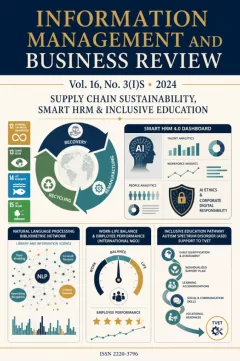 Vol. 16 No. 3(I)S (2024)
Supply Chain Sustainability, Smart HRM & Inclusive Education
View issue contents
Published
Submissions
Have research to publish? Information Management and Business Review welcomes submissions.
Make a Submission