Abstract
Social Influencers as environmental leaders utilize social media platforms to enhance community engagement in advocating sustainability. This study explores the underexplored role of micro-influencers in fostering pro-environmental behaviors among Malaysian youths and innovating community engagement by employing a qualitative approach in conducting semi-structured interviews with five micro-influencers. Our findings indicate the critical role of micro-influencers in raising awareness and actively engaging communities in adopting sustainable practices. The findings reveal three key themes: leadership qualities, proenvironmental behaviors, and persuasive narrative strategies. Through the innovative use of social media, these influencers overcome linguistic and geographical barriers, fostering enhanced community engagement in the pursuit of environmental stewardship. However, the sample size of five micro-influencers may limit the generalizability of the findings, as it may only partially represent the diverse range of micro-influencers. The result of this research can be used as recommendations for organizations, non-governmental organizations and governmental bodies that can leverage the insights from this study to strategically engage micro-influencers in environmental campaigns, recognizing their unique ability to reach and resonate with specific communities, particularly Malaysian youths. This study offers a novel perspective on digital environmental leadership by uncovering the unique role of micro-influencers in fostering community engagement and cultivating a culture of sustainability. It provides original insights into how these emerging leaders not only inspire but also empower communities to take meaningful action toward environmental preservation. The study highlights the underexamined potential of micro-influencers in exceeding traditional barriers to community engagement, offering valuable implications for future strategies in environmental advocacy.
Keywords
- Micro-influencers Search this journal for Micro-influencers (opens in a new tab)
- Community Engagement Search this journal for Community Engagement (opens in a new tab)
- Environmental Leaders Search this journal for Environmental Leaders (opens in a new tab)
- Social Media Search this journal for Social Media (opens in a new tab)
- Millennials Search this journal for Millennials (opens in a new tab)
- Sustainable Behaviors Search this journal for Sustainable Behaviors (opens in a new tab)
References
- Akers, K. L. (2018). Leading after the boom: Developing future leaders from a future leader’s perspective. Journal of Management Development, 37(1), 2-5. https://doi.org/10.1108/JMD-03-2016-0042
- Akerlof, K. L., Timm, K. M., Rowan, K. E., Olds, J. L., & Hathaway, J. (2022). The growth and disciplinary convergence of environmental communication: A bibliometric analysis of the field (1970–2019). Frontiers in Environmental Science, 9. https://doi.org/10.3389/fenvs.2021.814599
- Ardévol, E., Martorell, S., & San-Cornelio, G. (2021). Myths in visual environmental activism narratives on Instagram. Comunicar, 29(68), 57-67. https://doi.org/10.3916/C68-2021-05
- Audrezet, A., De Kerviler, G., & Moulard, J. G. (2020). Authenticity under threat: When social media influencers need to go beyond self-presentation. Journal of Business Research, 117, 557-569. https://doi.org/10.1016/j.jbusres.2018.07.008
- Awang, S. F. L. Q., Annuar, S. N. S., & Gisip, I. A. (2021). The effect of social media influencer Attributes towards pro-environmental intention. Romanian Journal of Information Technology and Automatic Control, 31(1), 111–124. https://doi.org/10.33436/v31i1y202109
- Basit, A., Sebastian, V., & Hassan, Z. (2017). Impact of leadership style on employee performance (A Case study on a private organization in Malaysia). International Journal of Accounting & Business Management, 5(2), 112-130. https://doi.org/24924/ijabm/2017.11/v5.iss2/112.130
- Bazarova, N. N., Walther, J. B., & McLeod, P. L. (2012). Minority influence in virtual groups: A comparison of four theories of minority influence. Communication Research, 39(3), 295–316. https://doi.org/10.1177/009365021139975
- Bennett, G., & Williams, F. (2011). Mainstream green: Moving sustainability from niche to normal. The Red Papers, 1(4), 6–120.
- Berestova, A., Alizade, T., & Umirzakova, Z. (2020). The role of social networks in the educational process. International Journal of Emerging Technologies in Learning, 15(22). https://doi.org/10.3991/ijet.v15i22.16889
- Chen, B., & Madni, G. R. (2023). Achievement of a sustainable environment through the effectiveness of social media in the Z generation of China. Plos one, 18(11), e0292403. https://doi.org/10.1371/journal.pone.0292403
- Chwialkowska, A. (2019). How sustainability influencers drive green lifestyle adoption on social media: The process of green lifestyle adoption explained through the lenses of the minority influence model and social learning theory. Management of Sustainable Development, 11(1), 33-42.
- Clugston, R.M.(2004). Foreword. In P.B. Corcoran, & A.E. Wals, A.E.( Eds.), Higher Education and the Challenge of Sustainability: Problematics, Promise and Practice (pp. 3–6). Kluwer Academic Publishers: Dordrecht, The Netherlands.
- Dekoninck, H., & Schmuck, D. (2023). The “greenfluence”: Following environmental influencers, parasocial relationships, and youth’s participation behavior. New Media & Society, 14614448231156131. https://doi.org/10.1177/14614448231156131
- Fry, R. (2016, April 25). Millennials overtake Baby Boomers as America’s largest generation. Pew Research Center, 25(4), 1-36. Retrieved from Pew Research Center: http://www.pewresearch.org/fact-tank/2016/04/25/Millennials-overtake-babyboomers/
- Galetti, M., & Costa-Pereira, R. (2017). Scientists need social media influencers. Science, 357(6354), 880-881. https://doi.org/10.1126/science.aao1990
- Genoveva, G., & Syahrivar, J. (2020). Green lifestyle among Indonesian millennials: A comparative study between Asia and Europe. Journal of Environmental Accounting and Management, 8(4), 397-413. https://doi.org/10.5890/JEAM.2020.12.007
- Ghazali, E. M., Nguyen, B., Mutum, D. S., & Yap, S. F. (2019). Pro-environmental behaviors and value-belief-norm theory: Assessing unobserved heterogeneity of two ethnic groups. Sustainability, 11(12), 3237. https://doi.org/10.3390/su11123237
- Gill, P., Stewart, K., Treasure, E., & Chadwick, B. (2008). Methods of data collection in qualitative research: interviews and focus groups. British Dental Journal, 204(6), 291-295. https://doi.org/10.1308.bdj.2008.192
- Glaser, B. G. (1978). Theoretical sensitivity: Advances in the methodology of grounded theory. Sociology Press.
- Gleason, B., & Von Gillern, S. (2018). Digital citizenship with social media: Participatory practices of teaching and learning in secondary education. Journal of Educational Technology & Society, 21(1), 200-212. https://www.jstor.org/stable/26273880
- Gräntzdörffer, A.J., James, A., & Elster, D. (2019). Exploring human-nature relationships amongst young people: Findings of a quantitative survey between Germany and South Africa. International Journal of Environmental & Science Education, 14(7), 417-424.
- Green, J., & Thorogood, N. (2009). Qualitative methods for health research. Sage, London.
- Green, W. S. M., & Leonard, E. E. (2019). The soft skills of leadership: Navigating with confidence and humility. Rowman & Littlefield Publishers.
- Hassan, S. H., Teo, S. Z, Ramayah, T., & Al-Kumaim, N. H. (2021). The credibility of social media beauty gurus in young millennials’ cosmetic product choice. PLoS ONE 16(3): e0249286. https://doi.org/10.1371/journal.pone.0249286
- Hemsley, J., Jacobson, J., Gruzd, A., & Mai, P. (2018). Social media for social good or evil: An introduction. Social Media+ Society, 4(3), 2056305118786719. https://doi. org/10.1177/2056305118786719
- Jalali, S. S., & Khalid, H. B. (2021). The influence of Instagram influencers’ activity on green consumption behavior. Business Management and Strategy, 12(1), 78-90. https://doi.org/10.5296/bms.v12i1.18265
- Kapoor, P. S., Balaji, M. S., Jiang, Y., & Jebarajakirthy, C. (2022). Effectiveness of travel social media influencers: A case of eco-friendly hotels. Journal of Travel Research, 61(5), 1138-1155. https://doi.org/10.1177/00472875211019469
- Ki, C. (2018). The drivers and impacts of social media influencers: The role of mimicry. PhD diss., University of Tennessee. https://trace.tennessee.edu/utk_graddiss/5070
- Kumar, P. (2016). State of Green Marketing Research over 25 Years (1990-2014): Literature survey and classification. Marketing Intelligence & Planning, 34(1), 137–158. https://doi.org/10.1108/MIP-03-2015-0061
- Lim, S. F. (2005). Environmental Management and Environmental Education in Two Schools in The Klang Valley. Master thesis. University of Malaya, Kuala Lumpur.
- Lim, X. J., Radzol, A. F., Cheah, J., & Wong, M. W. (2017). The impact of social media influencers on purchase intention and the mediation. Asian Journal of Business Research, 7(2), 19-36. https://doi.org/10.14707/ajbr.170035
- Liobikien?e , G., & Poškus , M.S. (2019). The importance of environmental knowledge for private and public sphere pro-environmental behavior: Modifying the value-belief-norm theory. Sustainability, 11(3324), 1-19. https://doi.org/10.3390/su11123324
- Lockie, M.A. (2018). In Vlogs We Trust Consumer Trust in blogs and Vlog Content. Unpublished PhD thesis, Auckland.
- Lokithasan, K., Simon, S., Jasmin, N. Z., & Othman, N. A. (2019). Male and female social media influencers: The impact of gender on emerging adults. International Journal of Modern Trends in Social Sciences, 2(9), 21-30. https://doi. org/10.35631/IJMTSS.29003
- Long, S. (2017). Exploring which leadership styles are effective with millennial employees. (Thesis - Doctoral). Minneapolis, MN: Walden University.
- Maass, A., Clark III, R. D., & Haberkorn, G. (1982). The effects of differential ascribed category membership and norms on minority influence. European Journal of Social Psychology, 12(1), 89–104. https://doi.org/10.1002/ejsp.2420120107
- Moyer-Gusé, E. (2008). Toward a theory of entertainment persuasion: Explaining the persuasive effects of entertainment-education messages. Communication Theory, 18(3), 407-425. htps:// doi: 10.1111/j.1468-2885.2008.00328.x
- Moyer-Gusé, E., & Dale, K. (2017). Narrative Persuasion Theories. In The International Encyclopedia of Media Effects (eds P. Rössler, C.A. Hoffner and L. Zoonen). https://doi.org/10.1002/9781118783764.wbieme0082
- Mustomi, D., & Reptiningsih, E. (2020). Gaya kepemimpinan dalam perspektif generasi millenial. Jurnal Ilmiah MEA (Manajemen, Ekonomi, & Akuntansi), 4(1), 189-199. https://doi.org/10.31955/mea.vol4.iss1.pp189-199
- Naderi, I., & Steenburg, E.V. (2018). Me first, then the environment: Young millennials as green consumers. Young Consumers, 19 (3), 280-295. https://doi.org/10.1108/YC-08-2017-00722
- Nafees, L., Cook, C.M., Nikolov, N.N., & Stoddard, J.E. (2021). Can social media influencers (SMI) power influence consumer brand attitudes? The mediating role of perceived SMI credibility. Digital Business, 1 (2), 1 - 10. https://doi.org/10.1016/j.digbus.2021.100008
- Nerb, J., & Spada, H. (2001). Evaluation of environmental problems: A coherence model of cognition and emotion. Cognition & Emotion, 15(4), 521–551. https://doi.org/10.1080/02699930126254
- Nguyen, T. H., & Zhang, H. (2020). Green lifestyle, where to go: How social media influencers moderate the intention–behavior gap within the ecological lifestyle context. Master thesis. Jonkoping University, Sweden. https://www.diva-portal.org/smash/get/diva2:1430761/FULLTEXT01.pdf
- Okuah, O., Scholtz, B.M., & Snow, B. (2019). Grounded theory analysis of the techniques used by social media influencers and their potential for influencing the public regarding environmental awareness. In: Proceedings of the South African Institute of Computer Scientists and Information Technologists 2019. pp. 1–10. https://doi.org/10.1145/3351108.3351145.
- Patton, M.Q. (2002). Qualitative research and evaluation methods. 3rd Sage Publications; Thousand Oaks, CA.
- Peattie, K. (2010). Green consumption: behavior and norms. Annual Review of Environment and Resources, 35, 195–228. https://doi.org/10.1146/annurev-environ-032609-094328
- Puteri, R.D.H. (2018). The influencer and hedonist lifestyle of digital society. The Journal of Islamic Studies and International Relations, 3(1), 1-14. https://doi.org/10.5281/zenodo.6789734
- Radzi, N., Shafie, L.A., Rosaidi, N., Razali, R., Lew, Y., & Akil, K. (2022). Profiling environmental leaders among social influencers: Perspectives of social followers. Borneo Science, The Journal of Science and Technology, 43 (2), 1 - 16. https://doi.org/10.51200/bsj.v43i2.4506.
- Rahman, H. A. (2018). Usaha dan cabaran dalam mengaplikasikan pendidikan alam sekitar dalam sistem persekolahan di Malaysia (Efforts and challenges in the application of environmental education in Malaysian school system). Asian Journal of Environment, History and Heritage, 1(2), 61– 70.
- Rathi,D., Given, L., Forcier, E., & Vela, S. (2014). Every task its tool, every tool its task: Social media use in Canadian non-profit organizations. In Proceedings of the CAIS. Retrieved April 5, 2015 from http://www. caisacsi.ca/ojs/index.php/cais/article/view/90
- Razak, N.F., & Sabri, M.F. (2019). Pro-environmental workplace intention behavior in the Malaysian public organization. Asian Social Science, 15(4): 60-68. https://doi.org/10.5539/ass.v15n4p60
- Rosaidi, N., Razali, R., Ling, L., Akil, K., Shafie, L.A. , & Radzi, N. (2022). Narrative persuasion of environmental leaders on social media: Case studies of two language educators. International Journal of Academic Research in Business and Social Sciences, 12 (1), 612-621. https://doi.org/10.6007/ijarbss/v12-i1/11688.
- Rose, P., Hunt, K.A., & Riley, L.M. (2018). Animals in an online world: An evaluation of how zoological collections use social media. Journal of Zoo & Aquarium Research, 6(2), 57-62. https://doi.org/10.19227/jzar.v6i2.324
- Rubin, H. J., & Rubin, I. S. (2005). Qualitative interviewing the art of hearing data (2nd ed.). Thousand Oaks, CA: Sage.
- Shamsuddin, A. A. (2003). Conceptual environmental understanding among form 4 geography students. Master thesis. University of Malaya, Kuala Lumpur.
- Skoric, M. M., & Zhang, N. (2019). Opinion leadership, media use, and environmental engagement in China. International Journal of Communication, 13(2019), 4602–4623.
- Solis, B., & Webber, A. (2012). The rise of digital influence: A "how-to" guide for businesses to spark desirable effects and outcomes through social media influence. Altimeter Group: CA, USA.
- Tamul, D. J., Holz-Ivory, A. H., Hotter, J. C., & Wolf, J. (2019, July 31). Fake News I Preregistration. https://doi:10.17605/OSF.IO/W6MSV
- Till, B. D., & Busler, M. (2000). The match-up hypothesis: Physical attractiveness, expertise, and the role of fit on brand attitude, purchase intent and brand beliefs. Journal of Advertising, 29(3), 1–13. https://doi.org/10.1080/00913367.2000.10673613
- Toker, S., & Baturay, M. H. (2019). What foresees college students’ tendency to use Facebook for diverse educational purposes? International Journal of Educational Technology in Higher Education, 16(1), 1-20.. https://doi.org/10.1186/s41239-019-0139-0
- Topic, M., & Mitchell, B. (2019). Generation Z & consumer trends in environmental. Packaging. Project Report. The Retail Institute, Leeds.
- Tsay-Vogel, M., & Schwartz, M. L. (2014). Theorizing parasocial interactions based on authenticity: The development of a media figure classification scheme. Psychology of Popular Media Culture, 3(2), 66-78. https://doi: 10.1037/a0034615
- Tsyetkova, M., Ushatikova, I., Antonova, N., & Salimova,S., & Degtyarevskaya, T. (2021). The use of social media for the development of digital literacy of students: From adequate use to cognition tool. International Journal of Emerging Technologies in Learning, 16(2), 65-78. https://doi.org/10.3991/ijet.v16i02.18751
- Weber, J. (2017). Discovering the millennials’ personal values orientation: A comparison to two managerial populations. Journal of Business Ethics, 143, 517–529. https://doi.org/10.1007/s10551-015-2803-1
- Wielki, J. (2020). Analysis of the role of digital influencers and their impact on the functioning of the contemporary online promotional system and its sustainable development. Sustainability, 12 (7), 1-20. https://doi.org/10.3390/su12177138
- Yang, M. X., Tang, X., Cheung, M. L., & Zhang, Y. (2021). An institutional perspective on consumers’ environmental awareness and pro?environmental behavioral intention: Evidence from 39 Countries. Business Strategy and the Environment, 30(1), 566–575. https://https://doi.org/10.1002/bse.2638
Downloads
No downloads have been recorded for this article yet. Figures appear here once readers begin downloading the full text.
How to Cite
Share this article
License
Copyright (c) 2024 Latisha Asmaak Shafie, Nor Alifah Rosaidi, Nor Azira Mohd Radzi, Ku Azlina Ku Akil, Razlina Razali, Lew Ya Ling (Author)

This work is licensed under a Creative Commons Attribution 4.0 International License.
Author (s) should affirm that the material has not been published previously. It has not been submitted and it is not under consideration by any other journal. At the same time author (s) need to execute a publication permission agreement to assume the responsibility of the submitted content and any omissions and errors therein. After submission of revised paper in the light of suggestions of the reviewers, the editorial team edits and formats manuscripts to bring uniformity and standardization in published material.
This work will be licensed under Creative Commons Attribution 4.0 International (CC BY 4.0) and under condition of the license, users are free to read, copy, remix, transform, redistribute, download, print, search or link to the full texts of articles and even build upon their work as long as they credit the author for the original work. Moreover, as per journal policy author (s) hold and retain copyrights without any restrictions.
Keywords
- Micro-influencers Search this journal for Micro-influencers (opens in a new tab)
- Community Engagement Search this journal for Community Engagement (opens in a new tab)
- Environmental Leaders Search this journal for Environmental Leaders (opens in a new tab)
- Social Media Search this journal for Social Media (opens in a new tab)
- Millennials Search this journal for Millennials (opens in a new tab)
- Sustainable Behaviors Search this journal for Sustainable Behaviors (opens in a new tab)
Section
Published in
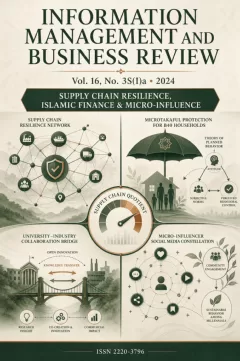 Vol. 16 No. 3S(I)a (2024)
Supply Chain Resilience, Islamic Finance & Micro-Influence
View issue contents
Published
Submissions
Have research to publish? Information Management and Business Review welcomes submissions.
Make a Submission